Please share our journey and support our work to build Heart Safe Communities by making a donation to

AWARENESS
Our aim is to create an environment in which anyone experiencing cardiac arrest has the very best chance of survival and good outcome. We believe that learning how to perform high quality CPR and becoming familiar with defibrillators increases confidence and willingness to help in an emergency
ANY OF US COULD SAVE A LIFE IF WE DO THIS
Not everyone survives cardiac arrest but we can work together to increase the chances
Heart Safe Communities UK currently offer training courses in areas local to their Head Office but the charity welcomes interest from others who would like to set up training courses in their locality. Training sessions can be a great way to meet others who can join our journey towards creating Heart Safe Communities throughout the UK. The charity can advise on the standards to use and suggest available resources that can help. Please contact us about this.
You might find the following information helpful
In the event of cardiac arrest it’s essential to do chest compressions (CPR) on someone who doesn’t have a detectable pulse to keep oxygen reaching the brain.
There’s no time to waste ……. SHOUT for HELP!
CALL 999
The call taker will be highly trained and will deploy an ambulance immediately. They will stay on the line with you and talk you through what you need to do.
It’s very tiring to do chest compressions for more than a few minutes, so you’ll need help.
SEND SOMEONE TO FETCH THE NEAREST DEFIBRILLATOR ……
If possible, get the victim onto a firm flat surface such as the floor.
BEGIN CPR
Quickly expose their chest and put both of your hands, one on top of the other in the centre of this chest in line with the nipples. Keeping your arms straight push down firmly on the centre of the chest at a rate of 100 -120 beats per minute. To help get the pace right, sing to yourself “Stayin’ Alive” by the Bee Gees, “Nellie the Elephant”or if you prefer “Baby Shark”.
You will need to push hard to compress the breast bone by 5-6 cm each time to squeeze the heart. It’s common to hear or feel a rib crack when you do this – don’t worry about this, just carry on.
USE THE DEFIBRILLATOR
Keep doing CPR when the defibrillator arrives. Let someone else put the pads on the persons chest and continue until the defibrillator tells you to stop. Do what it tells you to do. If a shock is delivered by the defibrillator, it will tell you to re-start compressions unless a pulse is detected.
The defibrillator WILL NOT shock someone if it’s not needed.
You should continue to do chest compressions and only stop if the collapsed person rouses, the defibrillator tells you to stop, if you become exhausted and cannot continue or when a first responder or paramedic arrives and takes over.
what3words
Find your what3words address
Many people live in homes, work or visit places where the traditional address / postcode is inaccurate and does not direct community responders, paramedics or other emergency services to their front door or precise location.
what3words can also be used to describe your location wherever you are including places that are unfamiliar, with no distinguishing features or obvious landmarks.
This is important in situations when every second counts.
You can be prepared for such circumstances
Save what3words addresses that matter so that you are prepared and can give it to healthcare workers / NHS 111 / 999 easily and quickly when needed.
Use what3words to tell emergency services precisely where you are.
Do not waste time searching for your what3words address in an emergency unless it really is needed to identify a hard to find location.
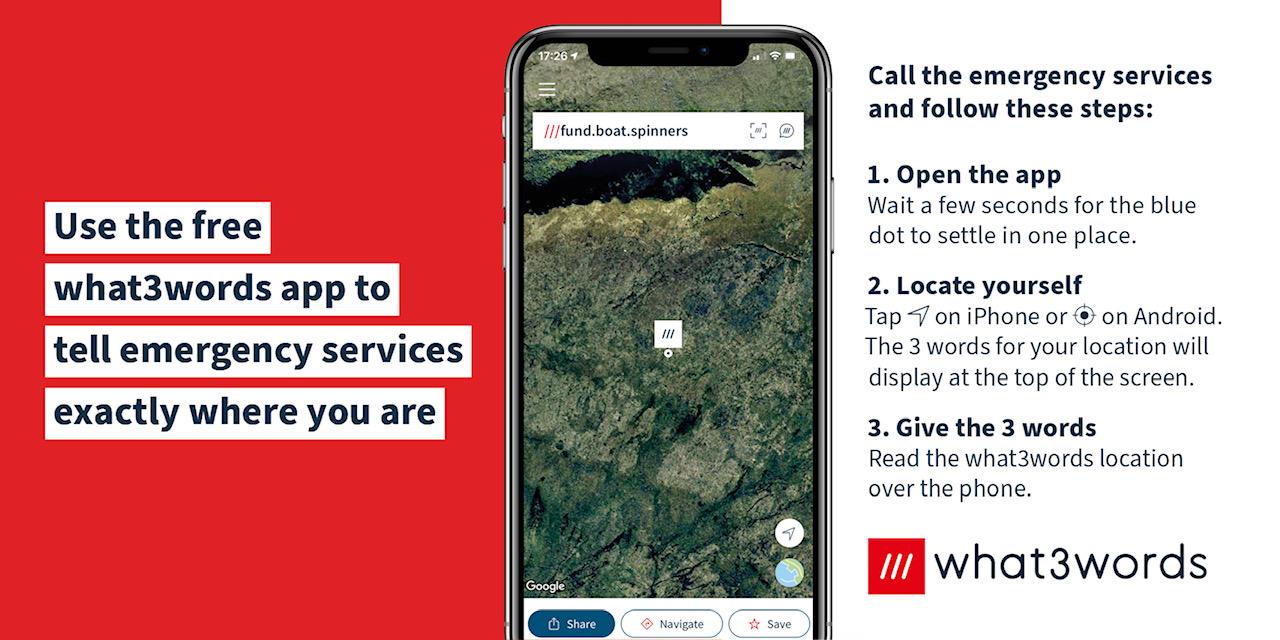
All references to what3words on the website have been added with the kind permission of what3words.
DID YOU KNOW...
Arrhythmias or heart rhythm problems are experienced by more than 2 million people a year in the UK. Most people with an abnormal heart rhythm can lead a normal life if it is properly diagnosed.
The main types of arrhythmia are:
- atrial fibrillation (AF) – this is the most common type, where the heart beats irregularly and faster than normal.
- supraventricular tachycardia – episodes of abnormally fast heart rate at rest.
- bradycardia – of the heart beats more slowly than normal.
- heart block – the heart beats more slowly than normal and can cause people to collapse.
- ventricular fibrillation – a rare, rapid and disorganised rhythm of heartbeats that rapidly leads to loss of consciousness and sudden death if not treated immediately.
Arrhythmias can affect all age groups, but atrial fibrillation is more common in older people. Drinking alcohol in excess or being overweight increases your likelihood of developing atrial fibrillation.
You may also be at risk of developing an arrhythmia if your heart tissue is damaged because of an illness – for example, if you have had a heart attack or have heart failure.
Atrial fibrillation is a common cause of stroke. Having atrial fibrillation means your risk of stroke is 5 times higher than for someone whose heart rhythm is normal.
Certain types of arrhythmia occur in people with severe heart conditions, and can cause sudden cardiac death. This kills 100,000 people in the UK every year. Some of these deaths could be avoided if the arrhythmias were diagnosed earlier.
Common triggers for an arrhythmia are viral illnesses, alcohol, tobacco, changes in posture, exercise, drinks containing caffeine, certain over-the-counter and prescribed medicines, and illegal recreational drugs.
Symptoms of arrhythmias include palpitations, feeling dizzy, fainting and being short of breath, although having these symptoms does not always mean you have a heart rhythm problem.
Arrhythmia Alliance's heart rhythm checklist can help you gather information to discuss with your GP if you have any of these symptoms.
If your symptoms persist or there's a history of unexplained sudden death in your family, it's important for your GP to refer you to a heart specialist (a cardiologist or electrophysiologist who specialises in heart rhythm disorders).
The most effective way to diagnose an arrhythmia is with an electrical recording of your heart rhythm called an electrocardiogram (ECG). If the ECG doesn't find a problem, you may need further monitoring of your heart.
This may involve wearing a small portable ECG recording device for 24 hours or longer. This is called a Holter monitor or ambulatory ECG monitoring.
If your symptoms seem to be triggered by exercise, an exercise ECG may be needed to record your heart rhythm while you are using a treadmill or exercise bike.
You should request a copy of your ECG. Take it with you to see the cardiologist or heart rhythm specialist and always keep a copy for future use.
Other tests used in diagnosing arrhythmias include:
- cardiac event recorder – a device to record occasional symptoms over a period of time whenever you have them.
- electrophysiological (EP) study – a test to locate problems with the electrical signals in your heart by passing soft wires up a vein in your leg and into your heart while you are sedated.
- echocardiogram(echo) – an ultrasound scan of your heart.
Source www.nhs.uk
It is not always possible to prevent an arrhythmia developing, although a healthy lifestyle can lower your risk of developing a heart condition.
Treatment aims to prevent future episodes. You can also make lifestyle changes so you avoid some of the triggers for your heart rhythm problem.
The heart's rhythm is controlled by electrical signals. An arrhythmia is an abnormality of the heart's rhythm. It may beat too slowly, too quickly, or irregularly.
These abnormalities range from a minor inconvenience or discomfort to a potentially fatal problem.
- High cholesterol is when you have too much of a fatty substance called cholesterol in your blood.
- It’s mainly caused by eating fatty food, not exercising enough, being overweight, smoking and drinking alcohol. It can also run in families.
- You can lower your cholesterol by eating healthily and getting more exercise. Some people also need to take medicine.
- Too much cholesterol can block your blood vessels. It makes you more likely to have heart problems or a stroke.
- High cholesterol does not cause symptoms. You can only find out if you have it from a blood test.
Fact: Exercise can help lower your cholesterol. Aim to see do at least 150 minutes (2.5 hours of exercise per week).
Further Information:
Heart UK has separate information about inherited high cholesterol that starts at a young age, called familial hypercholesterolaemia
Source and further advice from the NHS can be found at
It’s vital that everyone understands the difference between heart attack and cardiac arrest.
Both are life-threatening and require early recognition, a 999 call to the Ambulance Service and immediate help for the person affected.
Someone having a cardiac arrest due to any cause will be unconscious, they’ll be unresponsive, not breathing or not breathing normally.
A heart attack can lead to a cardiac arrest if it is severe enough.
Someone having a heart attack who is not having cardiac arrest will still be conscious and may be able to tell you what they are experiencing. They are likely to have chest pain which is severe. They may have pain in their arm or jaw. They may feel short of breath. They may look pale and have beads of sweat on their skin, but feel cold to touch.
Both of these situations are medical emergencies. Call 999, stay with the person and get help if you can.
You will not be criticised for calling 999 if later the person is diagnosed with something other than heart attack or cardiac arrest.
A heart attack is a serious life threatening emergency in which the supply of blood to the heart stops pumping blood around the body.
Symptoms of a heart attack can include:
- Chest Pain - the chest can feel like it's being pressed or squeezed by a heavy object, and pain can radiate from the chest to the jaw, neck, arms and back
- Shortness of Breath
- Feeling weak or lightheaded, or both
- An overwhelming feeling of anxiety
It's important to know that not everyone experiences severe chest pain. This is particularly the case with many women. The pain can often be mild and mistaken for indigestion.
It's the combination of symptoms that's important in determining whether a person is having a heart attack and not the severity of chest pain.
Cardiac Arrest is when your heart suddenly stops pumping blood around your body. When your heart stops pumping blood, your brain is starved of oxygen. This causes you to fall unconscious and stop breathing.
A victim will be:
- Unconscious
- Unresponsive - and
- Won’t be breathing or breathing normally - not breathing normally may mean the victim’s making gasping noises.
Without immediate treatment or medical attention, the person will die. If you see someone having a cardiac arrest, call 999 immediately, start CPR & send someone for a defibrillator if there’s one nearby.
CardioPulmonary Resuscitation. A technique for reviving someone whose heart has stopped beating by pressing on their chest and breathing into their mouth.
A defibrillator is a device used to restart a heart by giving an electric shock to the heart through the chest wall. It’s a portable device that’s designed to be used by people without any clinical training.
How to tell emergency services where you are:
You should give the emergency services your full address and postcode if known.
In addition to that what3words is the easiest way to describe any precise location. It has divided the World into 3 metre squares and given each one a unique identifier made from three words.
Some examples of how people use what3words are: telling friends exactly where to meet and easily giving a precise destination where needed e.g. when seeking help from the emergency services.
Businesses in travel, mobility and logistics, as well as some emergency response teams, use what3words to operate more efficiently and provide a better service.
what3words can be used via a free mobile app and the online map at what3words.com. You can find handy step-by-step instructions on how to use the what3words app at: http://what3words.com/how-to-use-the-what3words-app
If it’s dark put an outside light on and if you are in a place that might be hard to find e.g. down a farm track or hidden road / track it helps to have some one look out for the emergency services and direct them, but never leave a victim alone.
Blood pressure is a measure of force that your heart uses to pump blood around your body. It’s measure in millimetres of mercury (mmHg) and is given as 2 figures.
- Systolic pressure - the pressure when your heart pushes blood out.
- Diastolic pressure - the pressure when your heart rests between beats.
For example, if your blood pressure is “140 over 90” or 140/90mmHg, it means you have a Systolic pressure of 140 and a Diastolic pressure of 90mmHg.
As a general guide:
- Ideal blood pressure is considered to be between 90/60mmHg and 120/80mmHg
- High blood pressure is considered to be 140mmHg of higher
- Low blood pressure is considered to be 90/60mmHg or lower
Source and further advice from the NHS can be found at https://www.nhs.uk/common-health-questions/lifestyle/what-is-blood-pressure/
A stroke is a serious life-threatening medical condition that happens when the blood supply to part of the brain is cut off.
Strokes are a medical emergency and urgent treatment is essential.
The sooner a person receives treatment for a stroke, the less damage is likely to happen.
If you suspect that you or someone else is having a stroke, phone 999 immediately and ask for an ambulance.
Recognising the signs of a stroke:
The signs and symptoms of a stroke vary from person to person, but usually begin suddenly.
As different parts of your brain control different parts of your body, your symptoms will depend on the part of your brain affected and the extent of the damage.
The main stroke symptoms can be remembered with the word FAST:
- Face – the face may have dropped on 1 side, the person may not be able to smile, or their mouth or eye may have drooped.
- Arms – the person may not be able to lift both arms and keep them there because of weakness or numbness in 1 arm.
- Speech– their speech may be slurred or garbled, or the person may not be able to talk at all despite appearing to be awake; they may also have problems understanding what you're saying to them.
- Time – it's time to dial 999 immediately if you notice any of these signs or symptoms.
It's important for everyone to be aware of these signs and symptoms, particularly if you live with or care for a person who is in a high-risk group, such as someone who is elderly or has diabetes or high blood pressure.
Other possible symptoms
Symptoms in the FAST test identify most strokes, but occasionally a stroke can cause different symptoms.
Other signs and symptoms may include:
- complete paralysis of 1 side of the body
- sudden loss or blurring of vision
- dizziness
- confusion
- difficulty understanding what others are saying
- problems with balance and co-ordination
- difficulty swallowing (dysphagia)
- a sudden and very severe headache resulting in a blinding pain unlike anything experienced before
- loss of consciousness
But there may be other causes of these symptoms.
Further advice from the NHS can be found at https://www.nhs.uk/conditions/stroke/
Source www.nhs.uk
CHAIN OF SURVIVAL
How to maximise the chance of survival from sudden cardiac arrest
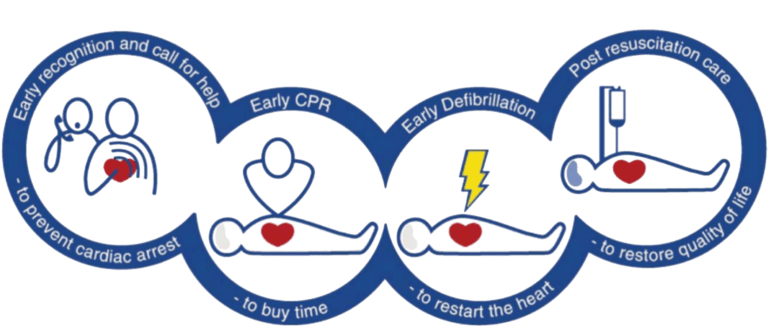
- Early recognition and 999 call – to ensure help is on the way
- Early CPR – to buy time
- Early Defibrillation – to restart the heart
GET IN TOUCH

Call 999
Do not delay. Be ready to identify your location. Use what3words if you don’t know the address, postcode or you are in an open space. If it is dark, put lights on inside and outside to help the emergency services find you quickly
CPR
Shout for help. Make sure someone has called 999. Start CPR as quickly as possible at a rate of 100 - 120 beats per minute, compress by 5-6 cm each time. Don’t stop unless you become exhausted, the person rouses or until help arrives
AED
After calling 999, start CPR and get someone to fetch the nearest defibrillator. Open the lid, attach the pads, follow the instructions and do what you are told. Continue with CPR when instructed. Don’t stop unless you become exhausted, the person rouses or until help arrives
Registered Charity No. 1196702